
Placido Disk 1880 | Antique Corneal Exam Tool
A Portuguese Ophthalmologist’s Lasting Innovation
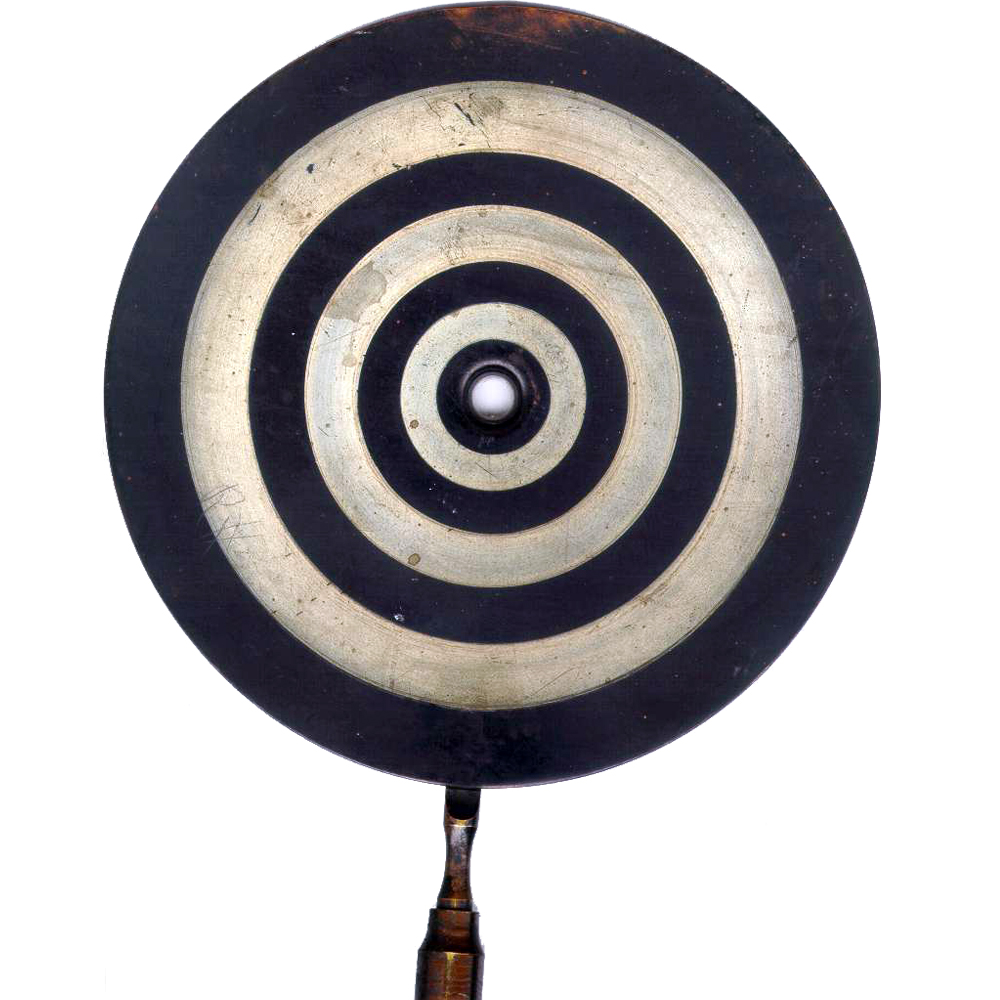
This Placido disk dates to 1880. Antonio Placido, a Portuguese ophthalmologist, first described this device in a paper published that same year, “Novo instrumento per analyse immediate das irregularitades de curvatura da cornea.” Practitioners used the Placido disk to qualitatively examine corneal irregularities and astigmatism, well before modern corneal topography existed. This simple, elegant instrument became a genuine milestone in ophthalmic diagnostics.
How the Placido Disk Reveals Corneal Shape
The disk carries alternating black and white concentric rings painted onto its surface. When an examiner held the disk in front of a patient’s eye, the rings reflected off the cornea’s surface. A healthy, regularly shaped cornea produced smooth, evenly spaced ring reflections. An irregular or steeply curved cornea, by contrast, distorted the reflected pattern in a way that revealed the specific nature of the irregularity. This example includes a small convex lens on the back side. That lens let the examiner view the reflected rings up close without needing to accommodate, making close examination considerably easier.
From Simple Disk to Modern Technology
Antonio Placido’s original 1880 design proved remarkably durable. French ophthalmologist Louis Émile Javal later incorporated the same ring principle into his ophthalmometer. By 1896, Allvar Gullstrand had adapted the disk into his own instruments as well. The core Placido ring principle still underlies modern corneal topography systems used in LASIK screening and contact lens fitting today, more than a century after Placido first described it.
Materials and Construction
This Placido disk is made of painted brass. It originally included a wooden handle, though that handle is now absent from this example. Despite the missing handle, the disk itself remains in good condition, preserving the painted ring pattern that made the instrument functional. Collectors interested in related diagnostic tools from this era may also want to browse our eye exam equipment collection.