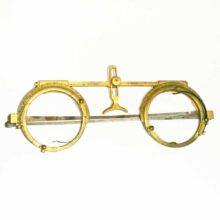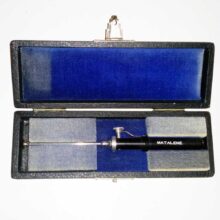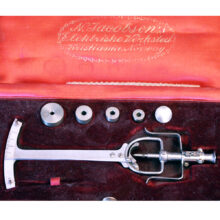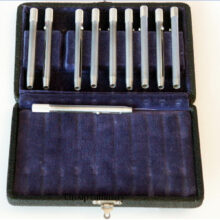

The DeZeng Phoropter of 1922 represents one of the earliest combined refraction instruments — an ingenious device that consolidated the many individual trial lenses of a traditional trial lens set into a single, self-contained instrument mounted on an adjustable arm in front of the patient’s eyes. Rather than the laborious process of individually selecting, handling, and inserting separate trial lenses into a trial frame, the phoropter allowed the examiner to cycle through a comprehensive range of spherical and cylindrical lenses by simply rotating dials, dramatically speeding up the refraction process and improving patient comfort.
The phoropter — whose name derives from the Greek “phoro” (to bear) and the Latin “opter” (one who examines) — was one of the most significant innovations in the history of clinical refraction. The DeZeng version of 1922 was among the pioneering commercial phoropters, arriving at a time when the instrument was still a novelty and most refractions were still performed with individual trial lenses in a trial frame. The complex arrangement of lens wheels, prism compensators, and auxiliary lens slots visible in this example reflects the remarkable mechanical ingenuity required to pack the equivalent of an entire trial lens set into a single instrument of manageable size and weight.
DeZeng’s phoropter eventually gave way to the instruments of American Optical and later Reichert, which became the dominant phoropter manufacturers for much of the twentieth century. Today the phoropter is the most universally recognized symbol of the optometrist’s and ophthalmologist’s examination room — and this 1922 DeZeng example stands near the very beginning of that history, making it a genuinely important artifact of ophthalmic examination technology. There is a good YouTube presentation about phoropters here .