
Antique Heidelberg Perimeter 90 Degree Rotating Arm 1883 | Jung Company Visual Field Instrument
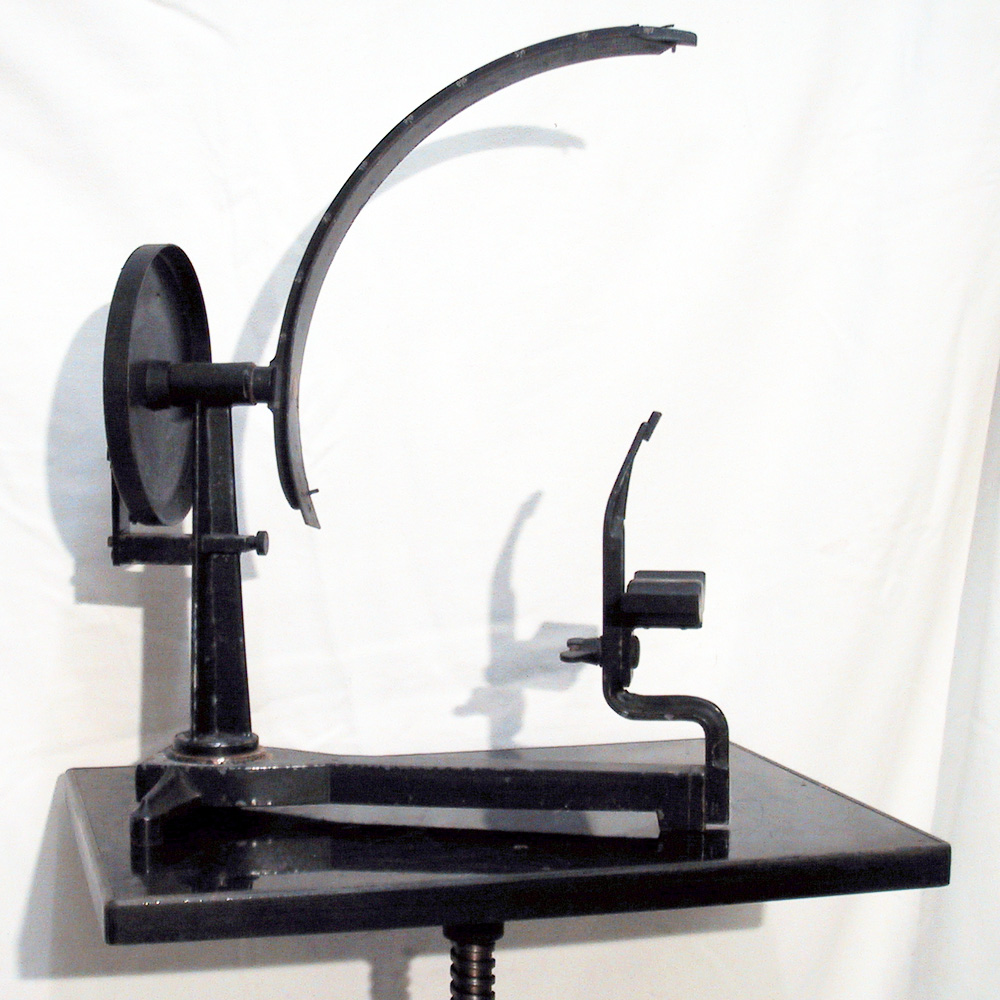

A rare and important antique Heidelberg Perimeter with 90 degree rotating arm, dating to around 1883, and representing a significant milestone in the history of visual field testing. This elegantly constructed cast iron instrument is a modification of the celebrated Priestley Smith perimeter, produced by the Jung company of Heidelberg — one of the distinguished German precision instrument makers of the era.
The history of this instrument type traces directly to Malcolm MacDonald McHardy (1852–1913), the ophthalmic surgeon who published the first perimeter with a quarter arc in 1882. The Heidelberg perimeter follows in this tradition, refining the design into a robust and clinically practical instrument capable of mapping the peripheral visual field with precision and repeatability.
The perimeter’s 90 degree rotating arc arm could be positioned at any meridian around the patient’s fixation point, allowing the examiner to systematically chart the full extent of the visual field in all directions. This capability made it an invaluable tool for following the success or failure of treatment of diseases such as chronic open angle glaucoma — a condition in which progressive peripheral field loss is one of the earliest and most critical signs of disease advancement.
A beautifully proportioned and historically significant piece of late 19th century German ophthalmic instrument making, and a compelling display piece for any serious collection.