
Electrical Hand Magnet Luer of Paris | Antique Intraocular Foreign Body Removal Instrument


The Electrical Hand Magnet by Luer of Paris, dating to the early 1900s, addresses one of the most challenging problems in early intraocular surgery — the removal of ferrous foreign bodies from the interior of the eye without causing further damage to the delicate ocular structures. Luer of Paris was one of the most celebrated surgical instrument makers of the late 19th and early 20th centuries, memorialized today by the universal “Luer-Loc” tip found on the end of syringes worldwide — a legacy that speaks to the firm’s extraordinary influence on surgical instrument design.
In the early days of intraocular surgery, ferrous foreign bodies — fragments of metal, steel filings, iron particles — presented a particularly dangerous challenge. Attempting to remove them mechanically with forceps risked catastrophic damage to the retina, lens, and other delicate structures. The development of the ophthalmic electromagnet in the 1870s offered a revolutionary alternative — by bringing a powerful magnetic field close to the eye, surgeons could draw ferrous fragments toward and out of the eye without mechanical contact, dramatically reducing surgical trauma. The hand magnet allowed this technique to be performed with precision and control, guiding the fragment toward the surgical incision under direct visualization.
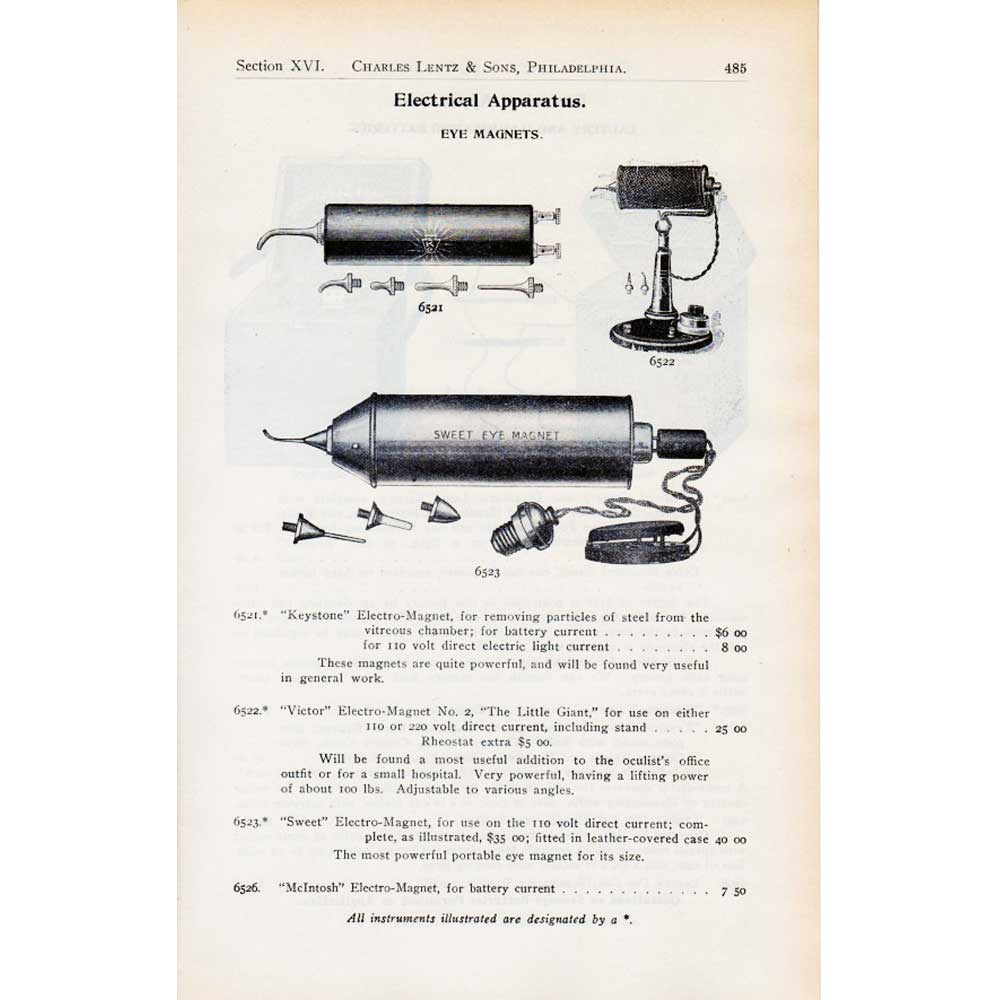
This model corresponds to the “Keystone” model shown in contemporary instrument catalogs, presented in its original fitted case with the main cylindrical electromagnet body and a set of interchangeable tips of different sizes and configurations for accessing different parts of the anterior and posterior segments. The striking orange-red velvet lining of the fitted case contrasts beautifully with the dark instrument body, making this a visually compelling piece as well as a historically significant one.