

The calibration bank for the Schiotz Tonometer is a precision accessory that was essential for maintaining the accuracy of one of the most important diagnostic instruments in the history of glaucoma management. The Schiotz tonometer, invented by Norwegian ophthalmologist Hjalmar Schiotz in 1905, became the standard instrument for measuring intraocular pressure worldwide for much of the twentieth century — and like all precision measurement instruments, it required regular calibration to ensure its readings remained accurate and clinically reliable.
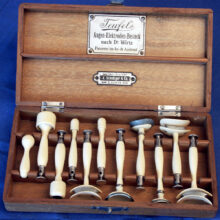
The calibration bank consists of a series of precisely machined metal test balls — visible as the row of brass and silver cylinders mounted on the brass rail in this example — each ground to an exact radius of curvature that simulates a specific intraocular pressure reading on the Schiotz scale. By placing the tonometer footplate on each test ball in sequence and verifying that the instrument reads the expected value, the clinician could confirm that the tonometer’s plunger, weights, and scale were all functioning correctly. Any deviation from the expected reading indicated that the instrument required cleaning, adjustment, or repair before being used on patients.
The importance of accurate tonometry cannot be overstated — an incorrectly calibrated Schiotz tonometer could produce falsely low or falsely high intraocular pressure readings, potentially leading to missed glaucoma diagnoses or unnecessary treatment. This calibration bank represents the careful attention to instrument maintenance and quality control that characterized conscientious ophthalmic practice throughout the era of Schiotz tonometry, and is a rare accessory that is seldom preserved alongside the tonometers it was designed to serve.