
Antique Lens Clamp for Refraction | Over-Refraction Optometric Tool
Antique Lens Clamp for Refraction — Over-Refraction Optometric Tool
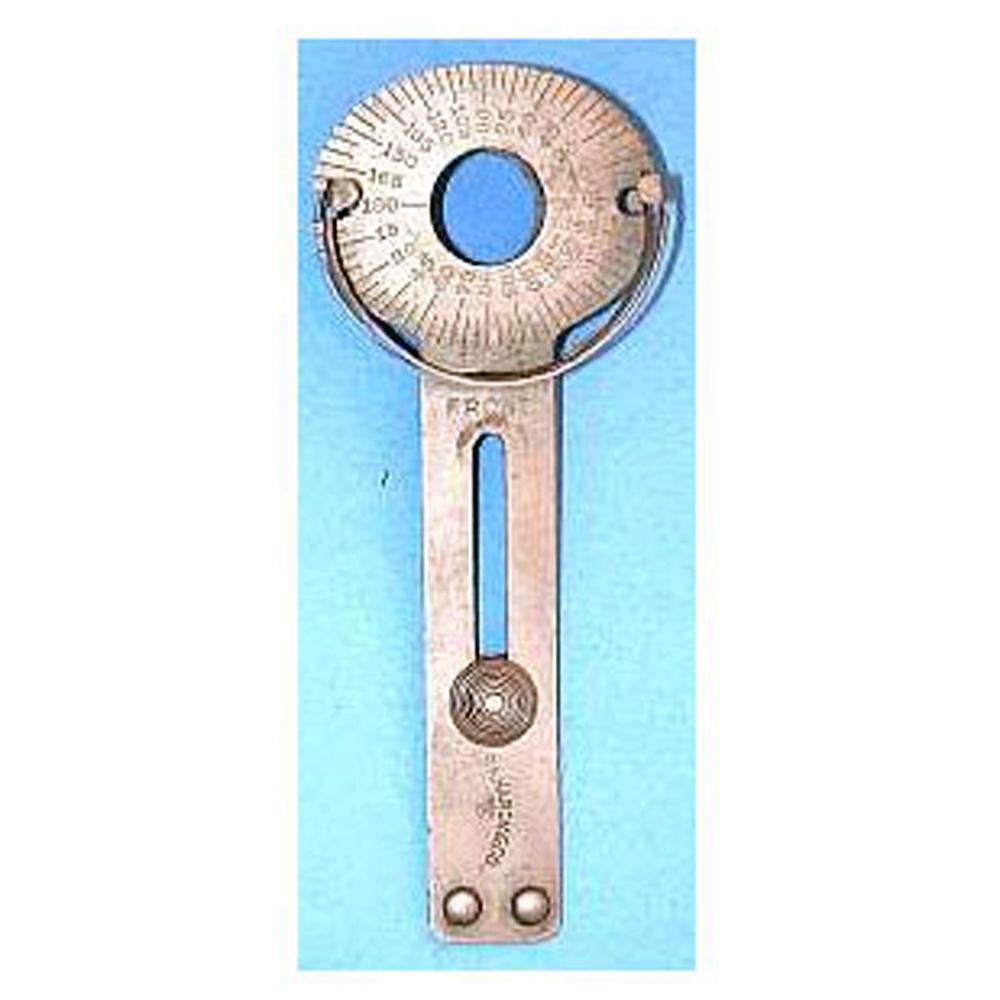
This antique lens clamp for refraction is a rare and intriguing piece of optometric history. It appears to date from the late 19th or early 20th century. Craftsmen made the instrument from aluminium and gave it a circular head with a central blue glass element, a graduated scale, and an adjustable clamping mechanism. Altogether, it raises fascinating questions about early refraction practice and stands as a genuinely unusual survivor from a poorly documented chapter of clinical optometry.
What Is a Lens Clamp for Refraction?
This aluminium clamp appears to have served over-refraction — the process of refracting over a patient’s existing pair of glasses. The clinician would clamp it onto one side of the spectacle lens, then insert trial lenses to improve or refine the patient’s vision. The instrument uses calibration in degrees, presumably for cylinder lens orientation. Consequently, this allowed the clinician to assess whether a change in cylinder axis or power would benefit the patient without removing their existing spectacles. To learn more about this technique, explore over-refraction in optometric practice.
Over-Refraction and Its Clinical Value
Over-refraction is the technique of refracting over an existing correction to determine whether a change is needed. Clinicians still use it today — particularly in contact lens practice. In the pre-autorefractor era, however, instruments like this lens clamp gave the optician a practical way to trial small changes in cylinder power and axis against the patient’s habitual prescription. Moreover, the degree scale on the head of the clamp allowed precise axis setting, making it a genuinely useful clinical tool.
Design and Construction
The blue glass central element stands out as the instrument’s most distinctive feature. It may have served as a filter or fixation target during the procedure. The graduated scale around the head allows accurate rotation to any cylinder axis. Furthermore, the clamping arms grip the patient’s existing spectacle frame securely during examination — a simple but effective solution for hands-free over-refraction.
Collectibility
This lens clamp for refraction is a genuinely rare and little-documented piece of clinical optics history. Very few examples appear in collections today. As a result, it appeals strongly to collectors of antique optometric instruments and researchers interested in the evolution of refraction techniques. Browse the full antique ophthalmic objects collection to discover similarly unusual pieces.