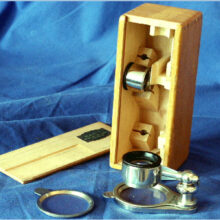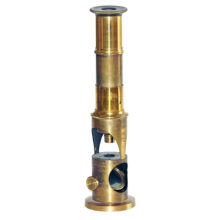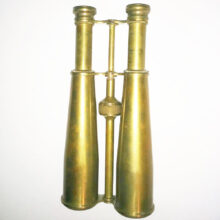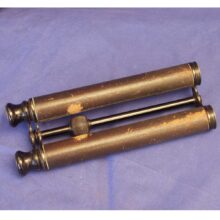


The Coddington Microscope, invented by Henry Coddington in 1829, represents one of the most elegant and ingenious solutions in the history of portable optical instruments. The Coddington lens is a single thick lens with two curved surfaces and a groove cut around its equator — the groove acting as an integral lens stop that blocks peripheral light rays and dramatically reduces spherical aberration, producing a surprisingly sharp and clear image despite the instrument’s extreme simplicity and compact size.
Henry Coddington was a Cambridge mathematician and Fellow of Trinity College who applied his theoretical understanding of optics to create a practical improvement on the simple magnifying lens. By combining the lens and stop into a single piece of glass, he eliminated the need for a separate diaphragm while simultaneously improving optical performance — a characteristically elegant solution that appealed to the Victorian scientific mind. The design was immediately recognized as a significant advance and was widely adopted by naturalists, botanists, geologists, and physicians who needed reliable portable magnification in the field.
This example, with its polished brass lens housing and turned wooden handle, is a beautiful specimen of the classic Coddington microscope form that remained popular throughout the nineteenth century and well into the twentieth. The wooden handle provided a comfortable, non-slip grip for extended examination sessions, while the brass lens housing protected the glass and gave the instrument the solid, professional feel expected of quality scientific equipment. Simple enough to slip into a coat pocket yet optically capable of revealing details invisible to the naked eye, the Coddington microscope was the essential field instrument of the Victorian naturalist — and this example remains a handsome piece of scientific instrument history.