
Knauer’s Ophthalmoscope 1890 | Antique Dual-Disc Eye Instrument
Knauer’s Ophthalmoscope 1890
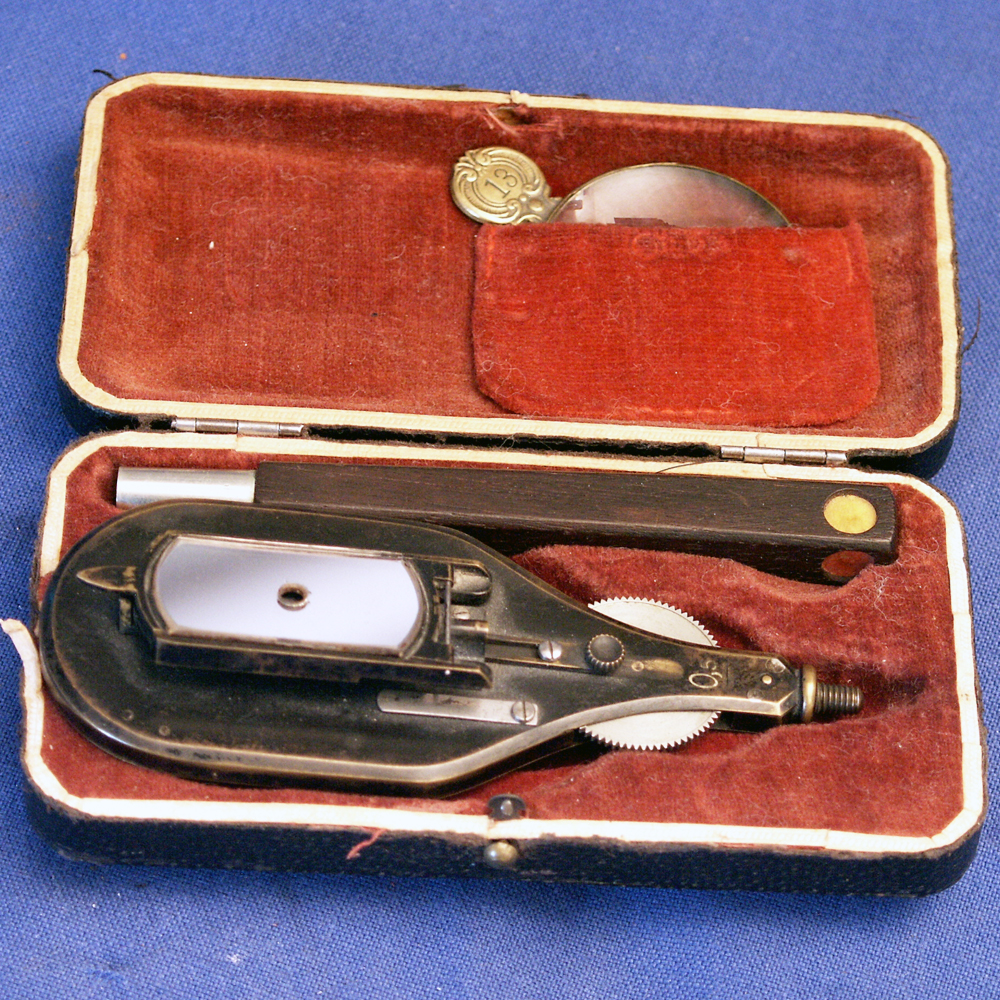
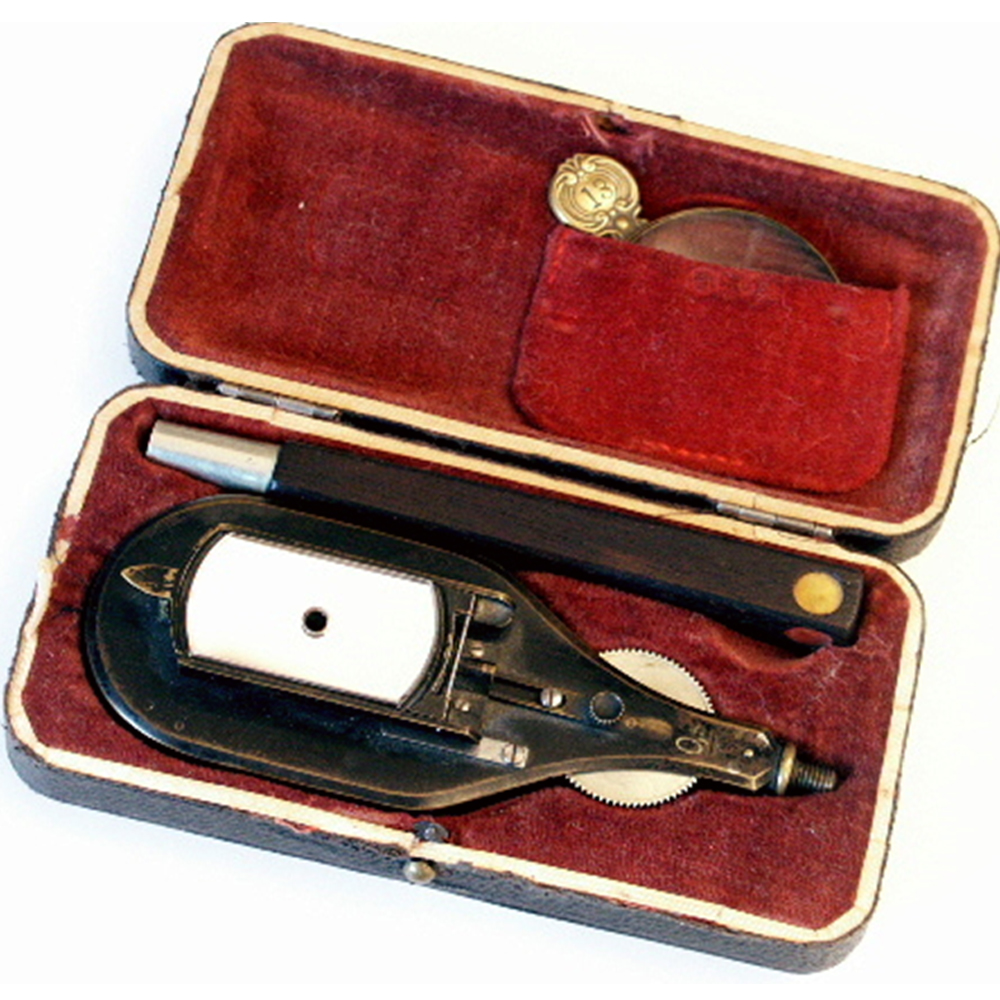
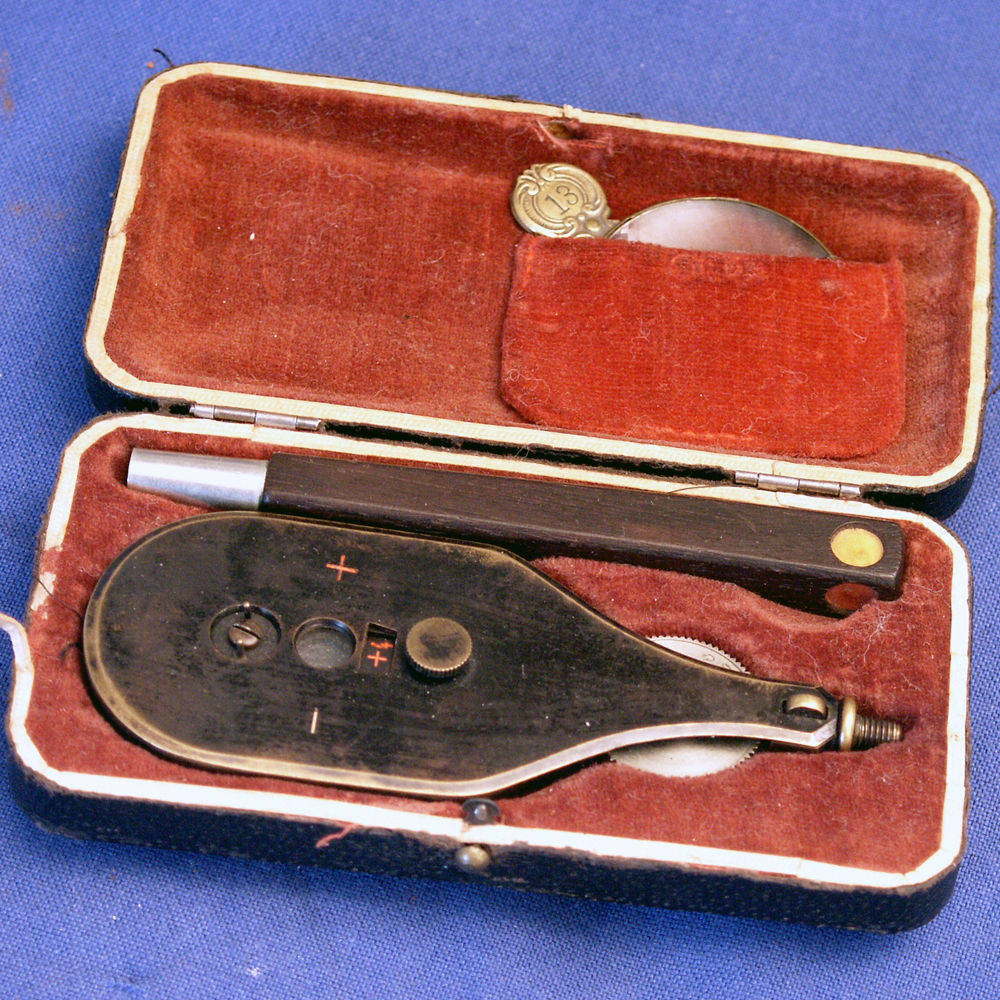
Knauer’s Ophthalmoscope is a rare and well-engineered antique eye examination instrument dating to 1890. It is presented in its original fitted case with rich red velvet lining. This is a technically sophisticated instrument with a cleverly designed dual-disc lens system that offered the examining clinician exceptional flexibility of power selection.
The Main Disc
The main disc carries 9 concave lenses: -1, -2, -3, -4, -5, -6, -7, -8, and -9 diopters, plus an empty opening. This gives the examiner a fine-stepped range of minus correction for use during fundus examination.
[Internal link: “Browse our full ophthalmoscope collection” → eyeantiques.com/shop/museum/ophthalmoscopes-museum/]
[External link: “Learn about the history of the ophthalmoscope” → en.wikipedia.org/wiki/Ophthalmoscope]
The Combination Disc
The combination disc carries 5 lenses: concave -10, -20, and -30 diopters, and convex +10 and +20 diopters, plus an empty opening. Together the two discs cover a wide range of correcting powers for both myopic and hyperopic examiners and patients.
Clever Power Stepping
A key feature of this design is its power stepping system. With the -0.5 diopter concave lens, the lens power can be increased or reduced by one half diopter. Lens values from -1.0 to -39.0 and from +1.0 to +20.0 diopters can all be achieved in one diopter steps. The lens powers can be read directly from the disc — a practical convenience that reduced examination time considerably.
Mirrors and Accessories
The instrument comes with both concave and plane mirrors, which can be angled and changed as needed. An additional convex lens of 36mm diameter and +13 diopters of power — the same as a standard trial lens of the period — is included along with a handle. This adds indirect ophthalmoscopy capability to an already versatile instrument.
Condition
The instrument is in good condition for its age. The red velvet lining of the fitted case is well preserved. All components are present and accounted for. This is a complete and display-worthy example of late Victorian ophthalmic instrument design. Learn about the history of the ophthalmoscope.
Browse our full ophthalmoscope collection.